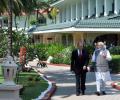
Big ticket defence deals including purchase of missile systems, frigates and joint production of helicopters were sealed on Saturday.

'The Opposition has no option but to make it an 'All versus One' fight to even think about winning.'

'Your constant reiteration on the lack of religious freedom in India has sown doubts about the kind of information that you are being fed and based on which you seem to be making adverse references to India and its tradition of religious tolerance.'
Continued uncertainty or confrontation in the Asia-Pacific is clearly in no one's interest as it will affect major powers' attempts to restructure their economies and revive growth. Conflict would roll back the gains to each of our countries of 40 years of stability and peace, says Shivshankar Menon.

'The strategy has to be restoring order in one part and countering the very effective propaganda through a very nimble monitoring and response system,' says Lieutenant General Syed Ata Hasnain, who retired as the General Officer Commanding of the Srinagar-based 15 Corps.

For 70 years the country has been looted, give me 70 months I will clean it up, he said.
A sensational interview on India-China ties, with the man most qualified to answer.

In this May 2014 interview with Vaihayasi Pande Daniel/Rediff.com, the politically conscious Karnad spoke of why he is concerned about Modi coming to power.
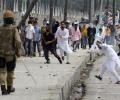
'There is a problem with the rise of a popular view that sees Kashmir through the prism of the larger, chronic Hindu-Muslim tensions.' 'By redefining the Kashmir problem simplistically in Hindu-Muslim terms could end up keeping Kashmir but losing most Kashmiris,' says Shekhar Gupta.

Nine young men killed in police firing last August have become symbols of oppression of the tribals of Manipur.

President Pranab Mukherjee on Monday addressed the first joint sitting of Parliament as mandatorily required under the Constitution after the general elections. The address is the political, economic and foreign policy road map of the Narendra Modi government and covers virtually all crucial areas.

'It is for the first time the voices of the most deferred, the most neglected, the most ignored, the most abused, the most vulnerable - the children-- has been heard. It is a great moment.' 'I always wanted Pakistan and India to have good relationships because I believe that this is very important for the development of both the countries.' 'If children are taught hatred, if they are taught about sectarianism and prejudice, then we can see that there will be terrorism in society." Nobel Peace Prize winners Kailash Satyarthi and Pakistan's Malala Yousafzai were given an ovation after they delivered their rousing speeches in front of a packed audience at a glittering ceremony in Oslo on Wednesday. A day later, they sit down for an interview with CNN's Christiane Amanpour and share their dreams, their hopes for the future. Read excerpts from the interview.

Pope Francis on Friday called upon the world community to put aside their "partisan interests and sincerely strive to serve the common good".

Veteran scientist P M Bhargava will return the awards he received from the government of India to protest against "the government's attack on rationalism, reasoning and science."

'The BJP politics of appropriating icons from its ideological adversaries could only be a desperate attempt to extend the Jat-Muslim divide in Uttar Pradesh. Why this desperation when it can comfortably get votes on the plank of economic development?'

The demand for OROP has been projected as an unambiguous issue but a good policy argument must have a sound economic element.

Following is the full text of Prime Minister Manmohan Singh's speech at the Central Party School in Beijing on Thursday:
'To re-establish the writ of the State and resume governance, frayed tempers in the streets and in the media need to be calmed.'

Modi today needs BJP CMs and non-party regional leaders to win votes and build alliances, but he will over-rule them and treat them like dirt once they have served their electoral purpose. Make no mistake: Modi is incurably authoritarian and will brook no dissent -- so long as the RSS is on board, says Praful Bidwai.
The Indian Army and more recently the Indian Navy have already set up dedicated intelligence branches. It is surprising indeed that the IAF, where real time and timely intelligence is most vital for effective and safe prosecution of the air war, has still not done so itself, says Group Capt (retd) P I Muralidharan.

If the chemistry between Modi and Xi Jinping goes well, it will herald a new future not just for the region but for the world, says Tarun Vijay.
he has to demonstrate the ability of his government to take a quantum leap, almost tantamount to setting the Ganga on fire, in the next six months, if not in 100 days, if the people were to take seriously the cascade of commitments spewing out of the President's address to both Houses of Parliament on June 9, says B S Raghavan. B S Raghavan suggests five practical propositions through which the Modi government can bring in paradigm changes.

In anticipation of a verdict to be delivered by the International Tribunal of the Permanent Court of Arbitration in The Hague on Tuesday, China has orchestrated a worldwide campaign to defuse its findings.

'The origins of the model of planned economic development adopted by independent India was a direct consequence of the war.' 'The war provided an opportunity for groups at the margins of Indian society to find new avenues for mobility.' 'The war also led to the emergence of India as a major Asian power and set the stage for it to play a wider role in international politics.'

The year 2014 is coming to an end. It was the year of conflict, the year of strife. Year 2014 will be remembered for several reasons -- the rise and threat of the Islamic State, the downing of two Malayasia Airlines aircraft and the sudden and effective way of using hastags on social media to generate a buzz about the event. After all, who can forget #theicebucket challenge and the phenomenon it grew into. Read on as we bring you an overview of international news and events of 2014.

On the occasion of Gandhiji's birthday, Rediff.com presents an excerpt from the book that shows how Gandhi changed the face of cricket as it was played then.

US Congresswoman Tulsi Gabbard, newly elected co-chair of the influential Congressional Caucus on India and Indian-Americans, discusses her vision for US-India ties with Rediff.com's Monali Sarkar.
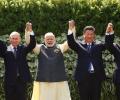
Narendra Modi's success at the BRICS summit is the best Diwali gift for India's diplomacy and marks her ascendancy to global leadership, says Tarun Vijay.

'I believe Modi mentioned Balochistan only to embarrass Pakistan and also divert attention toward the situation in Kashmir.' 'I think from now on, India intends to raise Balochistan whenever Pakistan brings up Kashmir or upsets them on the issue of terrorism.' 'Balochistan is the least developed of Pakistan's four provinces. It is the least educated and least economically developed. People are agitated that a region so rich in mineral resources and a sea-port is still so poor.' Baloch political analyst Malik Siraj Akbar on why the province wants freedom from Pakistan.

'Previous governments in India had reservations about working with Israel.' 'Modi has shed this tag.' 'Disengaging itself from its traditional and ideological foreign policy approach in the Middle East shall serve India's long-term interests.' Rajaram Panda explains why the significance of Modi's visit to the Jewish nation goes beyond markers like the first-ever visit to Israel by an Indian PM and 25 years of diplomatic ties.

'We have nothing to gain by helping any other country to become a threat to India,' former Sri Lanka president Mahinda Rajapaksa, who is on the comeback trail, tells Rediff.com in an exclusive interview.

It is rare for communal riots to spread to rural areas. The UP riot is the first time after the September 1969 Gujarat riots that a rural area have been affected. Electoral politics which divide society in majority/minority, going on since the early 1990s, is a major contributing factor to this heightened tension between communities, says Colonel (retd) Anil Athale in the first of a two part series.
Prime Minister Narendra Modi on range of issues -- from Rafale deal to Ram temple and triple talaq.

For distressed farmers in Mandya district of Karnataka, Madhuchandan is a true saviour.
It is a dark legacy bequeathed by Nehru to India. In its DNA lies the subconscious fount of India's schizophrenic geopolitics that forsook in one sweep all its historically-entrenched strategic interests in Tibet in favour of China, says R N Ravi, on the 60th anniversary of the Panchsheel Agreement.

The Pampore attack in Jammu and Kashmir "appeared to be" the handiwork of Lashkar-e-Tayiba terror outfit, Central Reserve Police Force Director General Prakash Mishra said.

With Beijing having had a profound rethink on India's admission as a full member of the Shanghai Cooperation Organisation, the tectonic plates of the geopolitics of a massive swathe of the planet stretching from the Asia-Pacific to West Asia are dramatically shifting. That grating noise in the Central Asian steppes will be heard far and wide -- as far as North America, says Ambassador M K Bhadrakumar.
NSA Menon's wisdom says that the idea to be superpower is not really desirable, it is better to be different. Sheela Bhatt reports.

'If you invest your entire capital in talks, you cannot abruptly change gear and decide on war.'

At the 53rd annual convocation ceremony of the IIT-Bombay, Nobel laureate Kailash Satyarthi shared stories of his struggle and victories.
